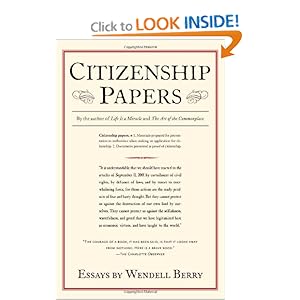
As usual, Wendell Berry says it more concisely and effectively than I did (in my previous post), in his essay, "The Agrarian Standard":
"In any consideration of agrarianism, this issue of limitation is critical. Agrarian farmers see, accept, and live within their limits. They understand and agree to the proposition that there is 'this much and no more.' Everything that happens on an agrarian farm is determined or conditioned by the understanding that there is only so much land, so much water in the cistern, so much hay in the barn, so much corn in the crib, so much firewood in the shed, so much food in the cellar or freezer, so much strength in the back and arms—and no more. This is the understanding that induces thrift, family coherence, neighborliness, local economies. Within accepted limits, these virtues become necessities. The agrarian sense of abundance comes from the experienced possibility of frugality and renewal within limits.
"This is exactly opposite to the industrial idea that abundance comes from the violation of limits by personal mobility, extractive machinery, long-distance transport, and scientific or technological breakthroughs. If we use up the good possibilities in this place, we will import goods from some other place, or we will go to some other place. If nature releases her wealth too slowly, we will take it by force. If we make the world too toxic for honeybees, some compound brain, Monsanto perhaps, will invent tiny robots that will fly about, pollinating flowers and making honey."
As usual, Berry, with candor and rigor uncommonly found among many politicians or corporate spokespersons, helps us see the world not as we wish it would be or as powerful interests wish it to be seen, but as it is.
A few months ago, I attended a lecture from Miroslav Volf, a very well-known theologian from Yale. The title of the lecture was, "The Intersection of Faith and Globalization," a lecture he's given a number of times in many places (see here as one example). The basic assumption of the lecture was something like this: globalization is here to stay, so we have to adapt to it. Now, I like where he goes on the basis of this assumption, but that's not where my problem lies.
My problem lies in the widespread belief that we should embrace a globalized world.
Globalization, as it currently stands, doesn't exactly resemble the democratic, egalitarian utopia that many proponents of globalization want us to believe. More importantly, even should every country and culture in the world get on board with living in a global community, even then we wouldn't live in a world governed by mutual consent and characterized by mutual prosperity. The reason for this isn't an outright cynicism on my part regarding human nature; it has to do with my cynicism regarding the forces that are leading to our increasingly globalized world.
Let's reflect for a moment on these forces (after the jump...)
I've been mulling over an old Scottish proverb lately: "Fools look to tomorrow; the wise use tonight." Ironically, it's been on my mind for some days, but I've put off actually writing about it for nearly a week. So what does that make me?
The notion of doing something "tomorrow," or postponing life for just a little while, isn't all bad. But what's struck me lately is the way that so many people—in religion, politics, advertising—utilize the idea of "tomorrow" to keep people from doing anything meaningful today. How many of the religious faithful have managed to avoid improving our world or tending to the poor, etc., because they were so confident that "tomorrow," that someday-paradise, a god would step in and make things right (or would remove the "righteous" from this wicked world). I think many religious leaders (though not all) intuit that if people realized they could do the work that they had assigned to God, then people would soon depend less on any god for their salvation, i.e., the health and welfare of our lives and planet.
Politicians use "tomorrow" very slyly, too, and usually to win political office. Look to Barack Obama. (Note: I'm in no way unappreciative of the things Obama has done in office; I'm more disenchanted with many of the promises on which he hasn't followed through. He's still the best option we've had in the U.S. for a while.) Obama's campaign, like so many other politicians at every level and from every party, was about getting voters to believe that with him in leadership, "tomorrow" would be a better place than today. Yet, for Americans at least, this has resulted in a dependency upon government to change the world that looks strikingly similar to that of religion. So now, many Americans sit and wait for government to improve their lives, to make a better "tomorrow," while the world around us begs for change today.